10/26/2026 10:00:00 AM | Football
His father encouraged him to chase a new dream. Through years of uncertainty, Roland Podesta carried that belief from Australia to Coastal Carolina
When Roland Podesta wondered how much longer he could keep chasing his football dream, he remembered his younger brother helping him carry their father's coffin.
Harry was 15. Roland was 22. Later, while working concrete jobs, packing boxes and stretching his earnings to afford another week of training in Melbourne, Australia, Podesta returned to that memory. Whatever difficulties he faced, he had already experienced something harder.
Even while fighting brain cancer, Anthony "Tony" Podesta wanted his children to keep moving forward with their lives.
"There's so much that he wanted me to do. Why would I quit?" Podesta said. "He never quit."
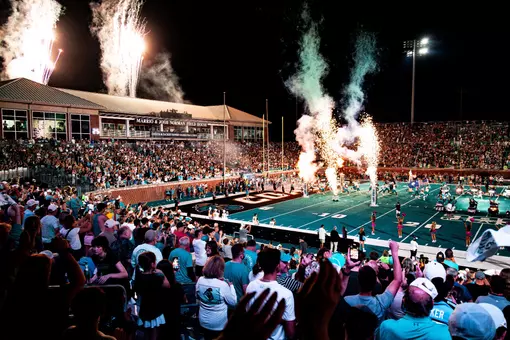
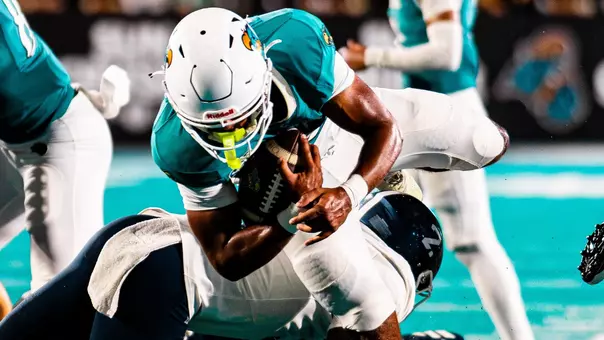
On Sept. 5, 2026, Podesta entered West Virginia's Milan Puskar Stadium for his Coastal Carolina debut, finally getting to play college football after years of working toward the opportunity.
"When I was there running out at West Virginia, it was just something I'll never forget," he said. "That was a long, long journey."
That journey began in his hometown of Windsor, near Sydney, Australia, where Tony was helping his son kick a ball before he could walk. Holding Roland underneath his arms, Tony would swing his son's legs toward a small, soft rugby ball. Later, Tony built PVC goalposts in the backyard, giving Roland somewhere to practice on the family's five-acre property.

"I'd just kick there all day," Podesta said. "I just loved it."
His parents ran a tennis coaching business, and he began playing at 3. By 12, he was helping teach children at holiday clinics, learning how to coach by watching Tony work.
Tony tried to attend every game and took a difficult performance as hard as his son did.
His mom drove him between swimming, tennis, track and field, and rugby league.
"Since a little age, I wanted to play in the National Rugby League," Podesta said.
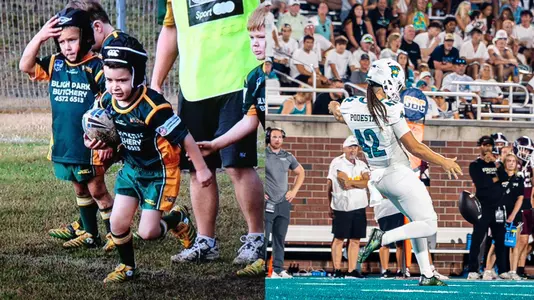
He started playing rugby league at 6 and grew up rooting for the Parramatta Eels, a professional club. As he got older, friends were selected for representative teams while he waited for his own chance.
"I'd always go home and pray that I got it because all my mates got it," he said. "I never got it. So I just kept training."
At 17, he joined the Manly Warringah Sea Eagles' junior program, moving a step closer to playing professionally. Once he got his chance to play on the wing, his kicking helped him stand out.
He missed so rarely that his teammates began joking about it. When they scored a try, rugby league's equivalent of a touchdown, they counted on him to make the conversion kick.

After a difficult season with Manly, Podesta received an invitation from Ireland's national rugby league team. He was eligible through his maternal grandparents.
He trained with the team in Manchester, England, before playing against Spain and then Italy in Dublin. Ireland won both games and qualified for the World Cup.
"That really kicked the confidence in me to be like, 'All right, you can do this,'" Podesta said.
But keeping up with rugby and work was wearing him down. After high school, he began working in the electrical trade, installing solar panels during the day before driving roughly an hour and a half to Manly for training. He often stayed afterward to practice kicking, then drove home to begin again the next morning.
Tony suggested that he teach other people to kick.
"I watched my dad coach my whole life," Podesta said. "I was coaching tennis since I was 12."
He started Podesta Academy in 2020, teaching young rugby players to kick. Coaching allowed him to work fewer hours and spend more time on his own training.

His cousin had often told him that if his only job in rugby league were to kick, he would be among the best. In American football, he learned, that could be his job.
During the COVID-19 pandemic, he saw rugby great Dan Carter try kicking an American football. Podesta thought doing the same would give him something to post for his academy.
He bought a ball, went to a local field and made his first attempt from 40 yards.
"From then I got hooked on it," Podesta said. "If I just do this, I can go somewhere with this."
A friend connected him with an American football club in Australia, where he kicked and punted. The helmet limited what he could see, and the shoulder pads felt heavy, but he liked how everyone on the field had a specific job.
"Everybody had a job," he said. "Everyone has to do their own one-eleventh."
He returned to Manly for another rugby season, but began thinking about college football as a way to live in the United States. He had wanted to return since a family trip in 2012.
When the pandemic cut his rugby season short, he decided to pursue college football. He tried out for Prokick Australia, which trains athletes to play the sport, and moved to Melbourne in January 2022.
Some people questioned why he would walk away from the sport he had always wanted to play professionally. Tony encouraged him to go, even as his health worsened.
"His big thing was the whole time, 'I don't want you to change your life because of what's going on with me,'" Podesta said.
Tony remained convinced he would recover. In May 2022, though, he called and asked Roland to come home. Roland returned to Windsor and stayed with his father until his death on July 27, then remained with his family for roughly two more months.

His mother encouraged him to return to Melbourne while she worked to support the family. Podesta said she had worked seven days a week since his father's death, keeping the lights on and paying the bills.
"She's the hardest worker I've ever known," he said.
He hoped to repay his mom for everything she had done. For now, he needed to earn enough to stay in Melbourne.
Some mornings began in the weight room at 5 before he headed to a concrete job. Other shifts involved packing boxes or unloading trailers, with full workdays fitted around training. He ate the same inexpensive meals often enough that friends still remember them: cereal for breakfast, eggs and rice for lunch, sausages and rice for dinner.
"All that money was going to my rent and my food," he said. "I didn't have a nickel to rub together at the end of the week."
Sometimes, he considered the alternative. He could have gone to England and earned money playing rugby. Instead, he was doing manual labor to cover his living expenses and pay for training, with no guarantee of a college opportunity.

Finding a college proved difficult, too. He moved back to Sydney when he thought he had a school lined up, only for it to fall through. He returned to Melbourne and found another place to live while people asked when he would give up on football and come home.
Remembering his father's fight with cancer helped him put those frustrations in perspective.
"He was fighting," Podesta said. "And I'm going to quit because I don't like my job?"
When Boise State offered him an opportunity, Podesta called his mom immediately. She cried.
"I just felt like a thousand tons just got lifted off my shoulders," he said.
He arrived at Boise State in January 2025. He could kick and punt, but began spending more time punting when a lower-body injury made place-kicking painful. He enjoyed learning the position, but the injury eventually required surgery.
In July, he returned to Australia to rehabilitate and pursue another opportunity. When the college season began, he watched from home, unable to kick.
"I was shattered," Podesta said. "I feel like everything I was working for just got taken away."
He worked nightclub security shifts to pay his bills and traveled roughly an hour and a half each way, four times a week, for rehabilitation. By late November, he was able to begin kicking again and returned to Melbourne to work with Prokick.
He wanted to enroll somewhere in January 2026, giving himself a spring to prepare with a new team. An opportunity with a Football Championship Subdivision program appeared promising until a coaching change left him searching again.
On New Year's Eve of 2025, he was working at the nightclub and worrying about how little time remained before classes would begin.
"I haven't even got a school," he remembered thinking.
He and his Prokick contacts shared his film on social media. Interest followed, and during a family trip up the coast, he received a call while sitting outside a gym with Harry.
John Smith from Prokick told him Coastal Carolina was interested. Special teams coordinator Nelson Fishback would call shortly.
Fishback had known about Podesta since his time coaching at New Mexico State. When he began looking for specialists at Coastal, he contacted Prokick and learned Podesta had completed his rehabilitation and was concentrating on punting.
Fishback liked what he saw on film. He also knew Podesta had already handled pressure playing rugby.
"Roland's an older guy. I mean, he's been through life," Fishback said. "He's competed in different sports than just football."

A kicker or punter can spend much of a game on the sideline before being called on in a pressure situation. Fishback wanted someone who had been tested, and Podesta had already made important kicks for his rugby teams.
What he saw, along with his trust in Prokick's coaches, convinced Fishback to offer Podesta a spot.
Podesta accepted and arrived at Coastal in January 2026. After years of stretching his grocery money, he appreciated being able to walk into Hicks Dining Hall and choose what he wanted to eat.
"Just the littlest things, I'm so grateful for," Podesta said. "Being able to go there today to Hicks and to be able to choose what I want to eat … just little things like that is such a cool thing."
Before Podesta's debut at West Virginia, Fishback encouraged him to trust his training and rely on his athletic ability.
"Just what you've always done in your life," Fishback recalled telling him.
On the ride to the stadium, Podesta answered a FaceTime call from two friends in Australia. They had finished working security at the nightclub where he once worked alongside them and were getting food on their way home.
They knew he had returned to America to play football, but it was difficult to explain that he was about to play in front of more than 54,000 fans at West Virginia. Later, when he shared videos, they began to understand.
Podesta laughed through the conversation, recognizing how recently their routine had been his own. A year earlier, he could have been eating a kebab alongside them after a shift. Now he was on a bus headed toward his first college game.
Entering the stadium, he reminded himself to enjoy the experience and trust the work he had done.
"I felt ready when I went out there," he said.
His first punt traveled 53 yards and was downed at West Virginia's 2-yard line. He returned to excited teammates, their congratulations helping him absorb what he had just done.
"I'm here," he remembered thinking.
He finished with six punts for 253 yards, averaging 42.2 yards per punt and placing four inside the 20. Through seven games, opponents have returned just four of Coastal's punts for a combined 16 yards.

Fishback has seen Podesta become more consistent as he learns to put less pressure on himself. When a punt goes wrong, Fishback reminds him that it doesn't change what he knows Podesta can do.
"We know you're a good player," Fishback said. "You wouldn't be here if you're not a good player."
At 26, Podesta is living a version of a dream he expected to reach much earlier. As a boy, he thought it would mean professional rugby. Later, he imagined moving quickly through training and into college football, finishing his degree by the age he is now.
"People always have a fixated timeline in their journey," he said. "I want to be this by this age, and this by this age."
Now he has more games to prepare for at Coastal and family and friends back home watching him play. He thinks about Harry, who works in metal fabrication in Australia, and hopes his brother finds encouragement in his experience when a job becomes difficult. He wants friends facing setbacks to know they can call him.
"I hope I can be a motivation to people that don't have the straight path in life," Podesta said.
His father encouraged him to leave home, and his mom supported him through the uncertainty that followed.
"At the end of the day, I want to make my brother proud," Podesta said. "I want my mom to be proud that I'm her son."